



Cofounnder
Find a co-founder. Build together.
Meeting people is the easy part. Knowing who to build with is not. Cofounnder helps you find the right person, and be sure about them, while it is still easy to change your mind.
Free on iPhone and Android. English and Lietuvių.
The problem
Most co-founder break-ups were predictable
The idea rarely kills a startup. The partnership does. Yet founders evaluate a potential co-founder with far less rigour than they would apply to a single engineering hire.
65%
of high-potential startups are estimated to fail because of co-founder conflict, not the product.
Months
of equity, time, and momentum are on the line before most founders ever stress-test the relationship.
Gut feel
is still how most pairs decide, a few coffees, shared excitement, and a handshake.
The exact numbers vary by study, but every founder who has lived through it tells the same story.
How it works
It starts with two strangers
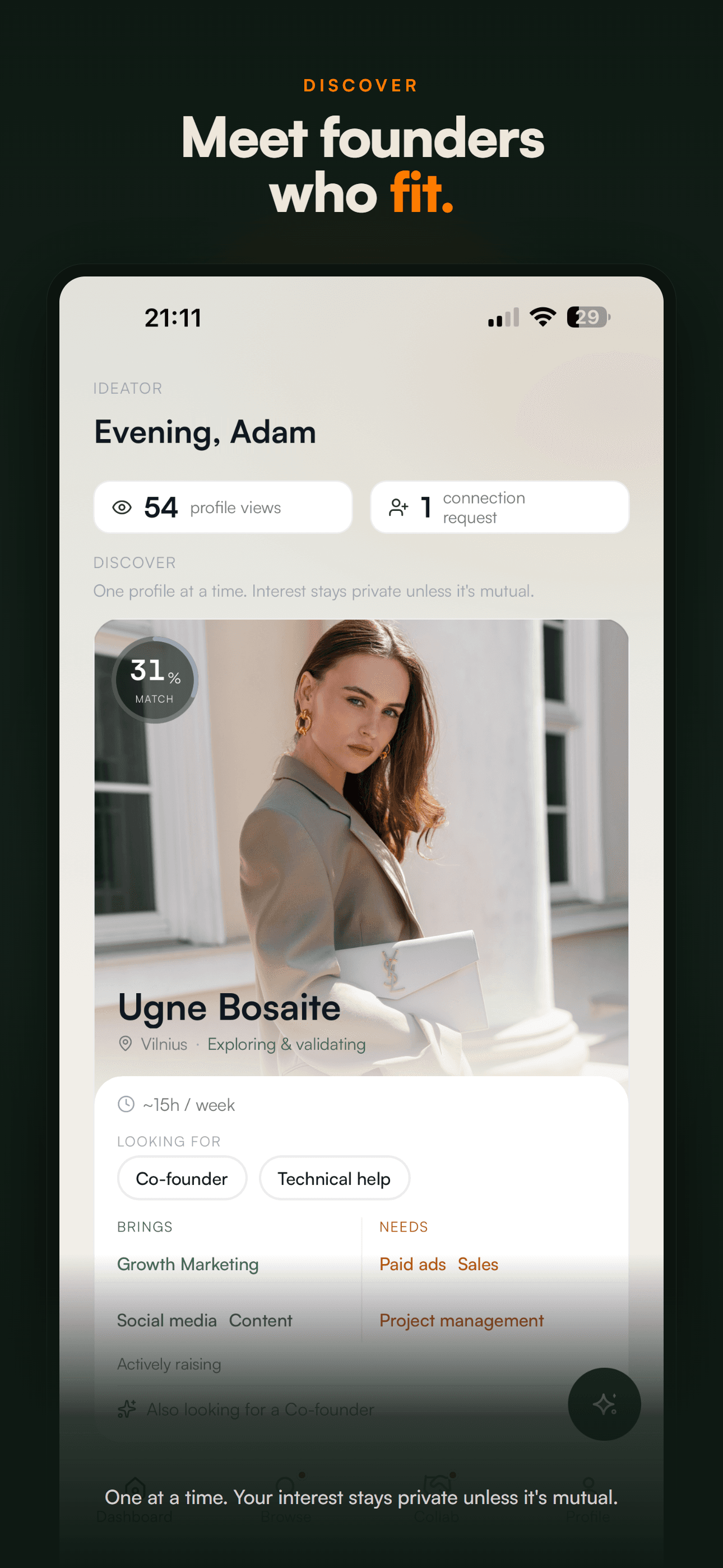
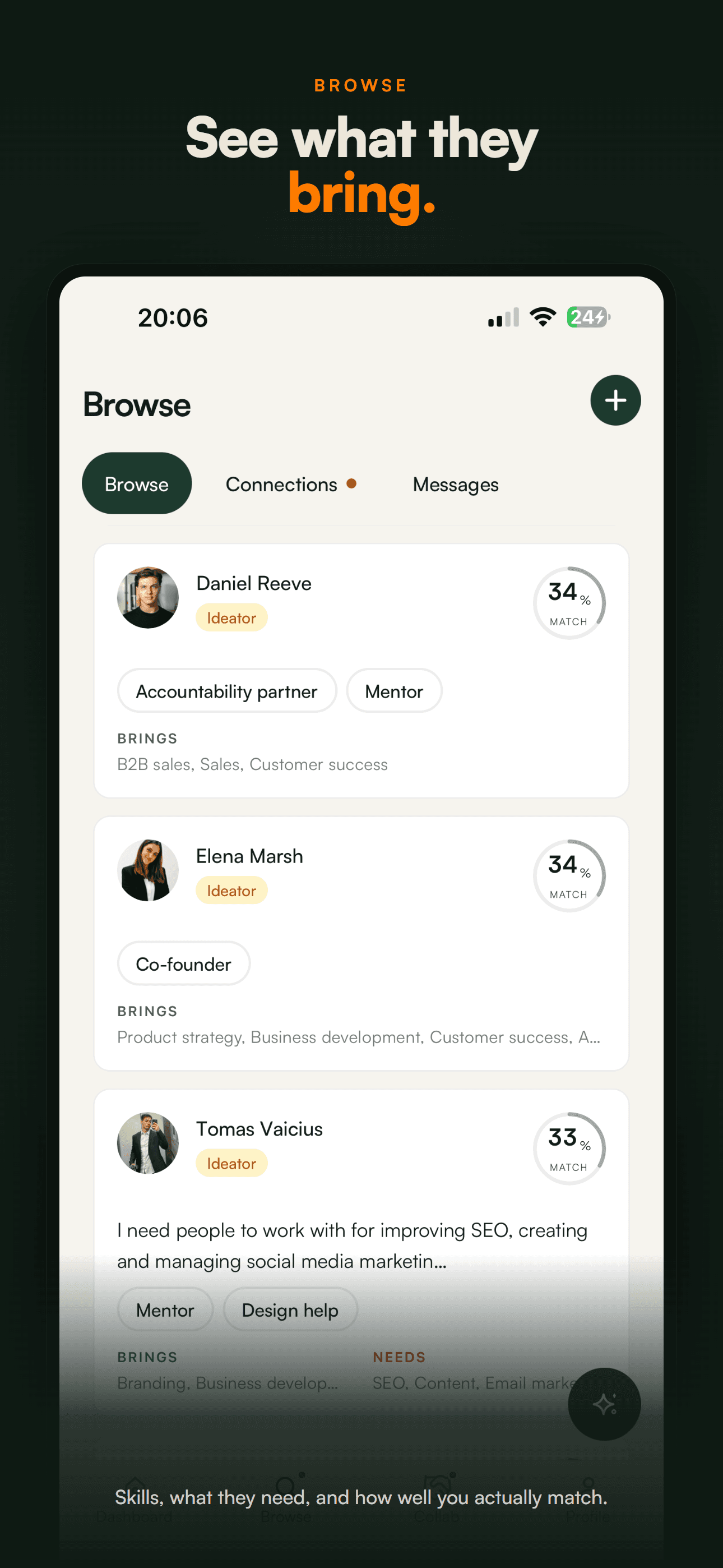
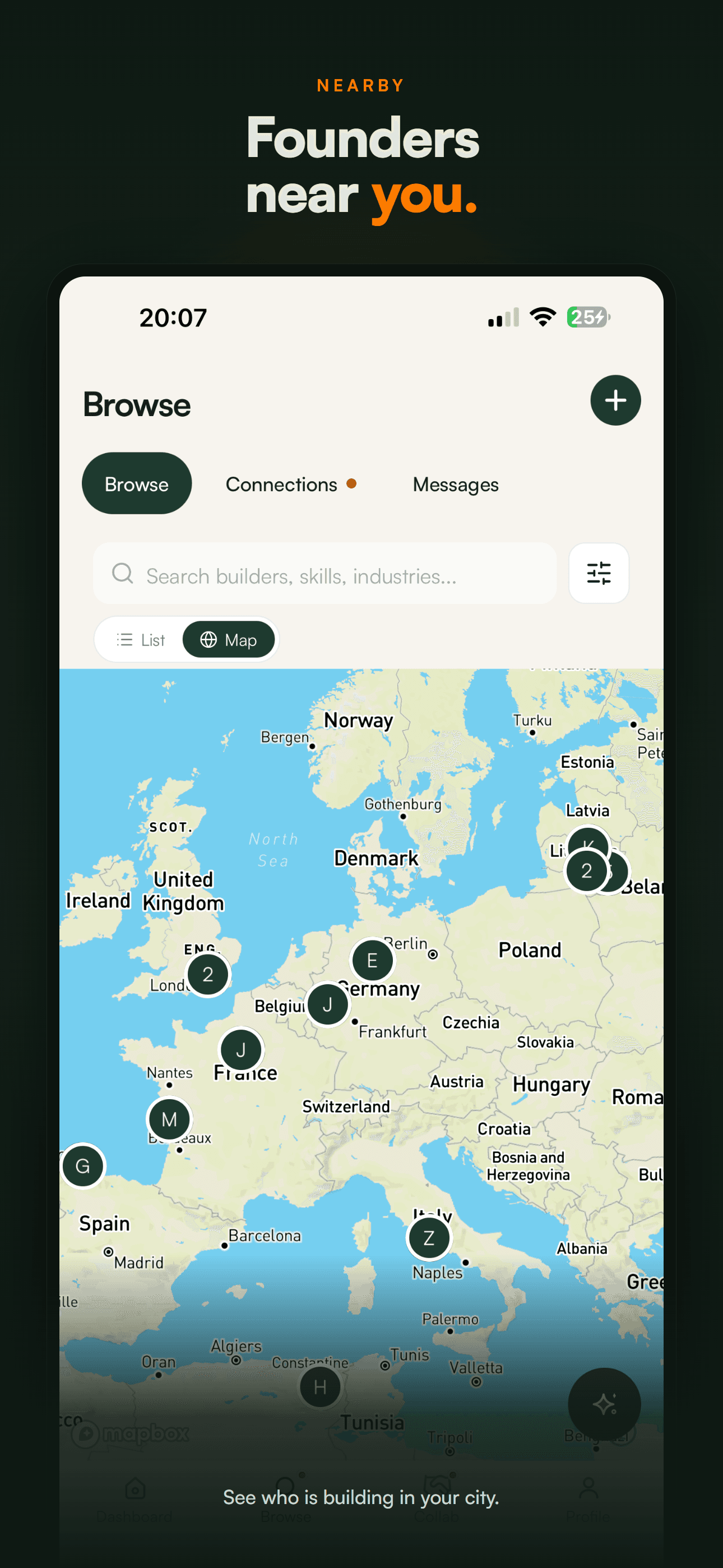
Say what you are building and who you need. Then meet the people building near you, one profile at a time or as a list and a map if you would rather search.
- STEP 01
Say what you are building
What you are working on and how far it has got, what you bring, and what you need someone else to bring. Then hours a week, pace, how you decide, and what you expect on equity. If the idea is still vague, the Idea Lab helps you get it down to one sentence first.
- STEP 02
Meet founders
One profile at a time. You see the same depth back, including their hours, their pace, their equity expectations and their evidence. Every profile carries a fit score based on what each of you brings and needs, so the ones worth reading come first.
What a profile carries
The venture
What you are building, the stage it is at, and what has actually been done so far.
What you bring
Skills, domain and professional background, picked from a shared list so two profiles can be compared.
Work you can point at
Portfolio, GitHub, product links and references, plus evidence of the things you have actually shipped.
Verified identity
A government ID or a quick selfie check, so a verified badge means a real person and not a pasted link.
What you need
The roles you are missing, and what you want the other person to own outright.
Hours and pace
Hours a week, timezone, and how fast you intend to move. The mismatch nobody checks early.
How you work
Working style, how you make decisions, and whether you are ready to trial something together.
Equity and commitment
The split you expect to hold, and how committed you are to this today rather than in principle.
Funding and investment
Whether the venture is funded, what has already been put in, and what is still being sought.
The match
Then it gets tested
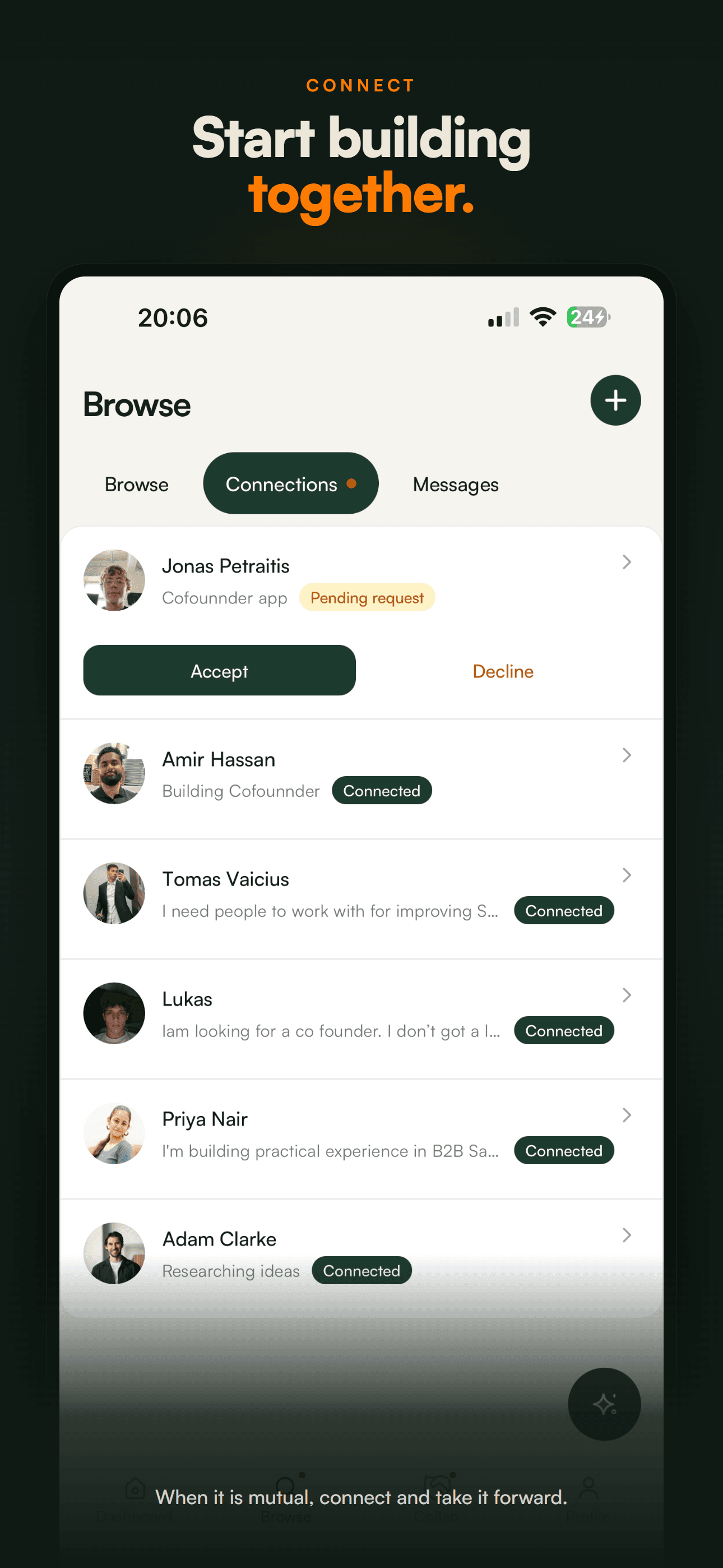
Interest stays private unless it is mutual, so there is no cost to being interested. When you both say yes the conversation opens, and the real work of finding out begins.
- STEP 03
Connect, then talk
Interest stays private unless it is mutual, so there is no cost to being interested and nobody gets unsolicited messages. When you both say yes, the conversation opens.
- STEP 04
Test the partnership
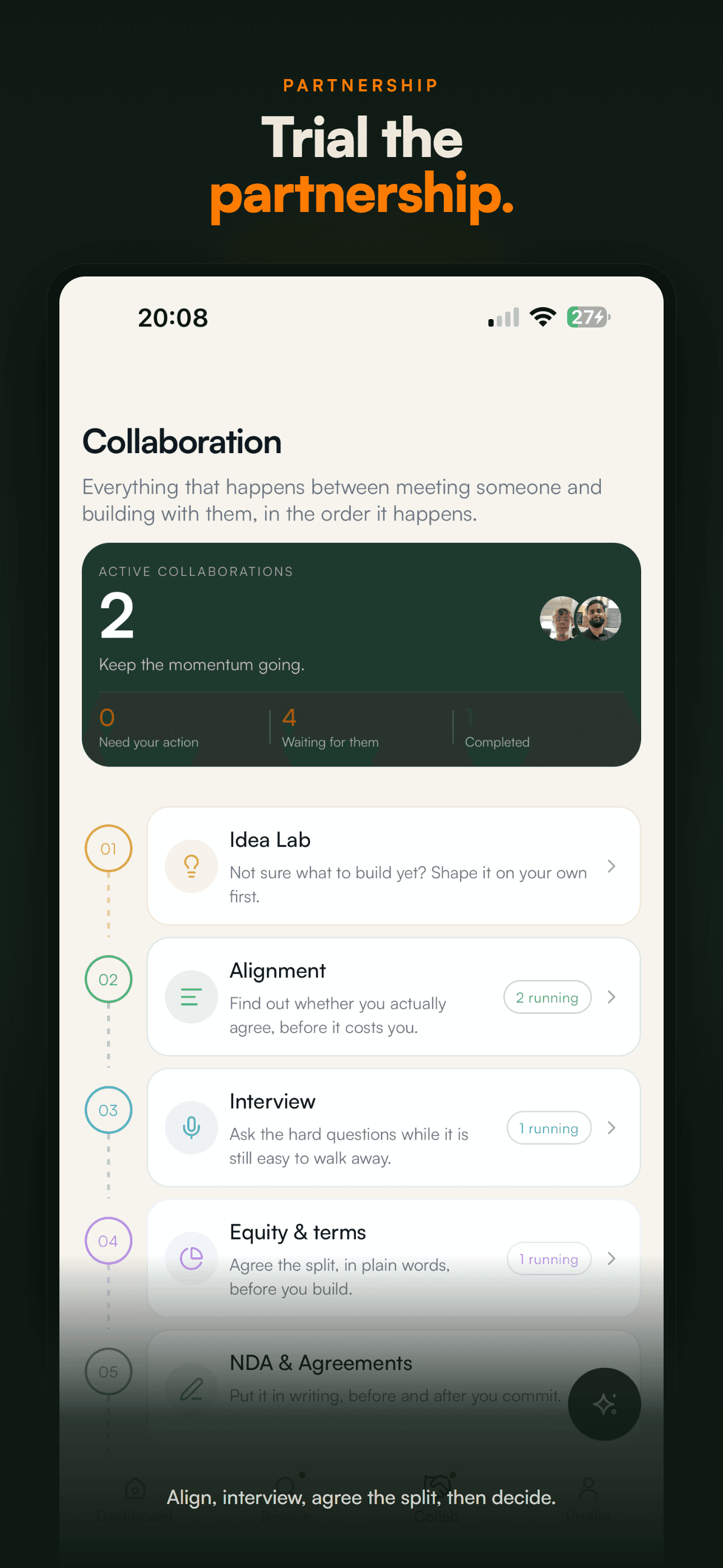
This is the part most founders skip. Work through alignment, interviews, equity and agreements together, at whatever depth the relationship has earned.
What's inside
Six ways to find out before you commit
Each one is a room you can walk into with someone, or on your own. Take them in order or take the one you need. Nothing is compulsory and nothing costs anything.
Idea Lab
Not sure what to build yet? Shape it on your own first.
Looking for a co-founder before you can say what you are doing is the hard way round. Answer a short set of questions, work through sprints, and come out with a brief you can put in front of anyone.
Half an hour to start · on your own
Alignment
Find out whether you actually agree, before it costs you.
Most partnerships do not fail on skills. They fail because two people wanted different things and nobody asked. You each answer the same questions alone, then see both sets side by side.
About 15 minutes each · with a partner
Interview
Ask the hard questions while it is still easy to walk away.
A real interview: you ask, they answer, you read. Written rather than spoken, so nobody has to think of the perfect follow-up on the spot and nobody can talk their way past a question.
10 minutes to send · with a partner
Equity & terms
Agree the split, in plain words, before you build.
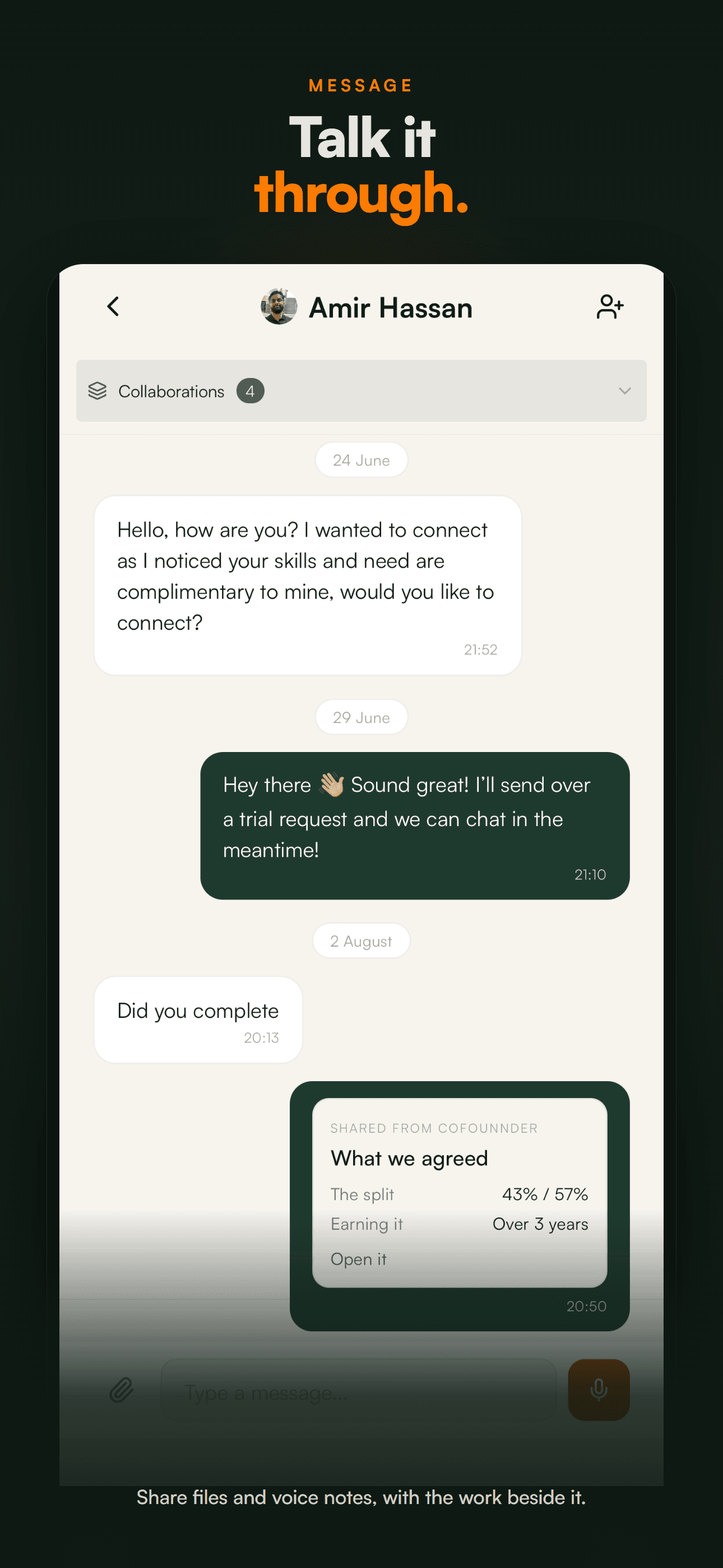
Four questions each, no jargon and nothing to type. You get a starting number and, more usefully, a clear view of anything the two of you see differently.
About 5 minutes each · with a partner
NDA & Agreements
Put it in writing, before and after you commit.
A mutual NDA for the early conversations and a partnership agreement for after you decide. Both fill themselves in from what you already agreed, and you sign with your finger.
10 minutes for an NDA · with a partner
Startup toolkit
Set the company up properly, one step at a time.
The paperwork nobody explains: what to register, in what order, and why. Fillable drafts, equity and runway calculators, and somewhere to keep the documents once you have them.
Go at your own pace · on your own
What you build
From a stranger to a signed agreement
Most co-founder tools stop at the introduction. Cofounnder covers the whole distance, from finding someone to writing down what you agreed, in one place and in the order it actually happens.
What you keep
A written record
An equity split in plain English, a signed NDA, a partnership agreement you both hold. Not screenshots of a chat, and not something one of you can quietly rewrite later.
What it costs to stop
Nothing
Every step is something you can walk away from. That is the point of doing them early, while walking away is still cheap and nobody has moved house or turned down a job.
Why it works
Built so the wrong things cannot happen
Every rule below exists because the alternative is what makes networking apps unpleasant. None of it is a setting you have to find.
Matched on what you need
A fit score built from what each of you brings and what each of you is missing, so it favours people who complement you rather than people who look like you.
Interest stays private
Nobody is told you were interested unless they are interested back. There is no cost to saying yes, and no way to be rejected in public.
No unsolicited messages
You cannot message someone who has not accepted a connection. There is no public feed and no way to broadcast at strangers, which removes most of what makes networking apps unpleasant.
Verified profiles
Every photo passes automated review before anyone sees it, and founders can verify their identity with a government ID or a liveness check to earn a badge.
Documents you both hold
NDAs, partnership agreements and equity summaries generated from what you agreed, signed in the app, and exportable as PDFs that live outside it too.
English and Lietuvių
The entire app, not just the menus, in both languages. Founders should not have to negotiate equity in their second language if they would rather not.
FAQ
The questions people actually ask
How much does it cost?
Free, all of it, including the equity tools and the agreements. No subscription, no trial, nothing behind a paywall. Money is tightest at the start, which is exactly when these decisions get made.
Is this a dating app for co-founders?
It starts the same way, and it is a good deal quieter. Interest stays private unless it is mutual, and nobody can message you without an accepted connection. Most of what is here is built for what comes after you meet.
What if I already have someone in mind?
Everything past the introduction is there for you too. Alignment, equity and the agreements work the same whether you met here or ten years ago.
Do I need an idea already?
No. Idea Lab turns something vague into a brief you can put in front of someone, before you go looking for a partner.
What if we decide we are not right for each other?
Then you found out early, which is the whole idea. Nothing commits you until you sign something. Finding out in week two costs a conversation; in year two it costs a great deal more.
Are the agreements real?
Yes. The NDA and the partnership agreement are documents you both sign and both keep, written in plain English. For anything with real money behind it, take them to a solicitor.
Does it use AI?
In places, and never for the decisions. It drafts interview questions you then edit, and helps you shape an idea while it is still fuzzy. It does not decide who you meet or whether a partnership is a good one.
Who is it for?
Anyone seriously thinking about building something with another person. First-time founders and people on their third company use it for the same reason: the partnership is the part you cannot undo cheaply.
How do you keep it safe?
Every profile photo is reviewed before anyone sees it, and anyone can verify their identity with a government ID or a liveness check. Report and Block sit on every profile and every conversation.
Don't bet years on a hunch
The right co-founder can make a startup. The wrong one can end it. Find out which one you have while finding out is still cheap.
Free on iPhone and Android. No subscription, nothing paywalled.